The trading ships made their way down the east coast of Africa stopping at towns to trade for African goods such as ivory, gold, myrrh to make a fine skin oil, animal skins, frankincense and ambergris used to make perfumes, and slaves. His first stop was Zeila, a port of the Christian kingdom of Ethiopia with a large Muslim community. He felt Zeila "the dirtiest, most disagreeable, and most stinking town in the world. The reason for its stink is the quantity of fish and the blood of the camels they butcher in its alleyways." To avoid the smell, Battuta spent the nights on his ship, even though the water was rough.
He continued southward and fifteen days later they reached Mogadishyu, the busiest and richest East African port. The Indian Ocean ports had long been active trading centers for Persian, Arabic, Indian and some European merchants. These merchants brought their languages, culture and religion to the region. For example, Ibn Battuta found that Mogadishu's sultan spoke both his native Somali and some Arabic and his chief legal advisor was Egyptian. But the East African trading ports were not isolated communities of foreign merchants. They were largely populated by black Africans speaking African languages like Somali in Mogadishu and Bantu further south). There was a great deal of intermarriage into the local families by the single Arab men who sought their fortunes along the coast of Africa. In some areas this coastal mingling of languages would finally develop into the language of Swahili which combines elements of Arabic, Bantu, and even some European languages.
Since Ibn Battuta was a real scholar of Islam religion and law now, he was made a welcomed guest of the local officials. This feasting and meeting of important people continued for about a week before the ship continued southward to Zanj and then Mombasa. They continued on to the islands of Pemba and Zanzibar, and finally arrived at Kilwa - today part of Tanzania.
Who were the people in the trading towns?
Settlers from Arabia and the Persian Gulf first introduced Islam into the little ports and fishing villages along the coast when they came to trade. The great majority of immigrants were males who married into local families. In Kilwa one family took control of the trading and gold markets from Zimbabwe. This family became very wealthy. They ate off Chinese porcelain, wore silk garments, and had indoor plumbing! Look at the ruins of the palace in which they lived.
What about slavery?
Ibn Battuta tells us several times that he was given or purchased slaves.
 Side Trip: Explore the many faces of slavery in Ibn Battuta's world.
He also tells us very briefly how slaves were taken and given as gifts.
The Sultan of Kilwa was called 'the generous' "on account of the multitude of his gifts and acts of generosity. He used to engage frequently in expeditions to the land of the Zinj people [villagers of the interior], raiding them and taking booty [slaves and other wealth]... He is a man of great humility; he sits with poor brethren, eats with them, and greatly respects men of religion and noble descent." [Gibb, vol. II, pp. 380 - 381]
Kilwa was important as a trading city for gold and its citizens enjoyed a high standard of living. The ruling class lived in stone houses up to three stories high with indoor plumbing. Most of the population lived in mud-walled houses with thatched roofs.
Ibn Battuta probably prayed in the Great Mosque of Kilwa which is now in ruins (below). Because Ibn Battuta's description of the East African coast is the only eye-witness account of the medieval period, it is studied in detail by historians.


 This was Ibn Battuta's first time at sea travel and he probably wasn't looking forward to it. The Red Sea was not easy to navigate with coral reefs and rocks just under the waterline. Storms were common, as were pirates who waited patiently for ships with rich travelers to rob and kill. Ships were weak in a storm - made of wooden planks that were stitched together with cords. Moreover, the winds could keep the sailboats from reaching their destinations. Truly the travelers' lives were in the hands of God.
 After a brief stay in Taiz, he continued down to the coastal city of Aden which guards the entrance to the Red Sea. Aden was a city built in the crater on an extinct volcano with the eastern side exposed to the sea. The harbor was surrounded by stone walls and sea gates for protection. Aden charged a tariff or tax on all the goods that came through this port. Ships brought spices, medicinal herbs, dyes to color cloth, iron, steel, Indian silks and cottons, pearls, cowrie shells (which were used for money in East Africa), Chinese pottery, African ivory, fruits and lumber.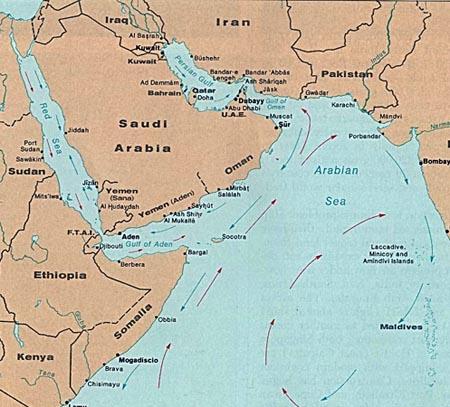


 Ibn Battuta stayed in Kilwa about two weeks and with the changes in the monsoon winds, the ship changed direction and went north. A month later he was back in South Arabia. From here he decided on another short adventure - this time to take a small ship to the Gulf of Oman. Because he disliked the crew of his ship, Ibn Battuta and a friend decided to continue to Qalhat on foot. This decision almost cost them their lives! A guide that they hired plotted to kill them and take their clothes and valuables. Fortunately, Ibn Battuta was carrying a spear and was able to control the wouldbe robber and finally - after becoming sick and thirsty and walking with swollen, bloody feet - they arrived at Qalhat. Here they stayed with the governor for six days and recovered.