Calicut
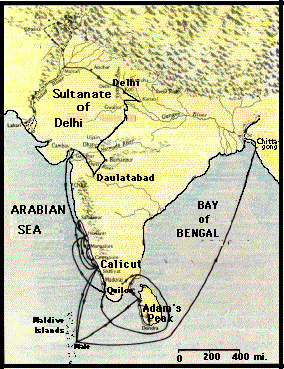
 Using the monsoon winds to propel them, the four ships headed south and arrived in the port of Calicut. There they were received with "drums, trumpets, horns, and flags... We entered the harbor amid great ovation [cheering] and pomp, the likes of which I have not seen in these parts." In the same harbor were 13 Chinese junks, probably much like the Song-era ship shown in this drawing. The junks were much larger ships than the dhows he had sailed on in the Indian Ocean. Ibn Battuta was impressed with the Chinese junks. They were much larger than a dhow, some with five decks and five masts or more! They had interior cabins and even private lavatories! The crew of a junk might be up to 1,000 workers! (Ibn Battuta did note that they weren't as safe as a dhow when travelling close to the shore). It would be on three of these large ships that they would continue to China. So the crew transferred the gifts including horses and slaves to the junks. Ibn Battuta spent the day in the mosque and planned to board the ship that afternoon.
But before he got on his ship, a terrible event occurred. A violent storm came up. Because the harbor was not very deep, the captains of the junks ordered the ships to wait out the storm in deeper water out to sea. Ibn Battuta waited helplessly on the beach all night and the next morning watched in horror as two ships were pushed onto shore, broke apart, and sank. Some of the crew on one of the junks were saved, but no one survived from the other ship - the one that he was supposed to be on.
"The slaves, pages, and horses were all drowned, and the precious wares either sank or washed up on the beach, where the [governor's soldiers] struggled to prevent the townsfolk from making off with the loot." [Dunn, pg. 225.]
The other ship carried Ibn Battuta's luggage, servants, and slave-girls - one of whom was carrying his child. The captain of that ship had set sail for China without him or the goods that he was to present to the Emperor of China.
Ibn Battuta was now alone, penniless, and ashamed - a failure as the leader for the trip to China for the Sultan of Delhi - but lucky to be alive. There was still a chance that he could catch up with the other ship, so he tried to track it down. After ten days he arrived in another port and waited for the ship which never turned up. (About three months later he learned that it had reached Indonesia and was seized by an "infidel" (i.e. non-Muslim) king of Sumatra. The slave-woman who was carrying Ibn Battuta's child had died. His other slaves and his possessions were taken by the king of Sumatra.)
Where was he to go? He wanted to return to the Sultan of Delhi, Muhammad Tughluq, but he feared that he would be executed for his failed trip. He decided it was safer to seek employment and protection from another Muslim sultan in southern India. To gain favor with this sultan Ibn Battuta actually joined in a day-long battle:
"On Monday evening we reached Sandapur and entered its creek and found the inhabitants ready for the fight. They had already set up catapults. So we spent the night near the town and when the morning came drums were beaten, trumpets sounded and horns were blown, and the ships went forward. The inhabitants shot at them with the catapults, and I saw a stone hit some people standing near the sultan. The crews of the ships sprang into the water, shield and sword in hand... I myself leapt with the rest into the water... We rushed forward sword in hand. The greater part of the heathens took refuge in the castle of their ruler. We set fire to it, whereupon they came out and we took them prisoner. The sultan pardoned them and returned them to their wives and children... And he gave me a young female prison... Her husband wished to ransom her but I refused." [Dunn, p. 227]
But when the next battle seemed to be an inevitable defeat, Ibn Battuta somehow managed to escape through the battle lines and headed down the coast reaching Calicut for the fifth time. Here he decided to continue on to China on his own. He knew that he could find hospitality in the Muslim communities along the way.
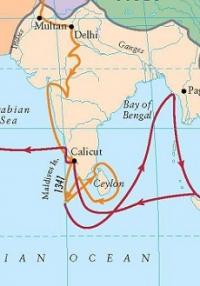
So he decided to continue on to China on his own. But again, he chose to take the long way - this time to make a brief tour of the Maldive Islands, then continue to Sri Lanka to make a pilgrimage to the sacred Adam's Peak. After that he would go on to China.

 Side Trip: Was conflict between religious groups a common Problem?
.JPG)
